Ask whose outcome is being estimated
A weight estimate needs an address: the population, circumstances and outcome to which it refers. Before asking whether a result is encouraging, write down whose experience the intended claim concerns. A claim about everyone facing a treatment decision and a claim about a defined collection of recorded outcomes ask different questions. Neither becomes more informative merely by using the broader language.
Three sets help organize the reading. The target population contains the people for whom an answer is wanted. The eligible population contains those who satisfy an entry rule. The analysis set contains the observations admitted by the calculation. These sets need not coincide. Moreover, the last is a set of records as well as people: a person could contribute an earlier measurement while lacking a later one.
Consider a hypothetical reader who wants an average outcome for everyone beginning a treatment. A calculation restricted to a particular observation pattern would require an additional argument before answering that request. The useful question is what connects the observed records to the proposed target, rather than whether the displayed average looks large. This distinction sets the order of interpretation: define the intended claim, identify the relevant records, and only then evaluate the estimate. It also prevents an apparently precise answer from quietly replacing the question the reader originally wanted answered.
Relate eligibility to the intended reader
SURMOUNT-1 enrolled adults without diabetes: BMI ≥30, or ≥27 with a weight-related condition. Participants were randomized to weekly subcutaneous tirzepatide or placebo for 72 weeks.[2]
An eligibility rule gives a claim a starting boundary. It should be compared with the intended population characteristic by characteristic, rather than compressed into a judgment that study participants are generally similar to readers. Similarity matters through its possible relationship with the outcome or treatment response. Matching an irrelevant feature would not resolve a difference in a feature that changes the scientific question.
Imagine a hypothetical study admitting only people with a particular background characteristic, while the intended audience includes people without it. An estimate within the admitted group does not directly identify the answer in the additional group. That gap is not evidence that an effect disappears outside the boundary. It is a request for a justified extension: what information connects the populations, and what would make that connection fail?
Simply changing the proportions of represented groups cannot recover information about a group with no representation. Where groups are represented, a proposed reweighting would still require suitable measurements and an explanation of which differences matter. Those are conditions to examine, not procedures being attributed to this analysis.
The Tirzepatide profile supplies separate identity context. For the population question, a useful reading note would name the intended audience and the eligibility difference requiring further evidence. This produces a specific uncertainty that another study could address, rather than a vague declaration that research never applies to real life.
Distinguish assignment from later group membership
Post hoc NVD groups were not randomized; one event qualified. Endpoint weight was required; data after treatment discontinuation were excluded.[1]
To see why assignment and membership require separate reasoning, imagine a hypothetical experiment with an initial allocation and a later classification. Draw the allocation first. Then draw a background characteristic that could affect both the later classification and the outcome. The initial allocation rule and the later classification rule now occupy different places in the argument.
Suppose, within this thought experiment, the classification can also be affected by assigned treatment. Restricting attention to a category formed afterward could connect treatment and the background characteristic through the act of selection. People reaching the same category need not have reached it for the same reasons. Consequently, the justification for comparing originally assigned groups cannot simply be carried over to every comparison made later.
This diagram is a proposed logical test, not a claim that a particular background variable caused bias in the reported result. It establishes what additional explanation would be needed for a causal interpretation. The magnitude and direction of any distortion cannot be read from the mere existence of a possible pathway.
A reader can therefore distinguish two requests. Describing outcomes among members of a category requires a clear membership rule. Estimating what would happen if membership itself were changed requires a defined intervention and a way to separate its consequences from the reasons people entered that category. If different routes to membership would have different consequences, even the proposed intervention needs more precise wording. A category label alone cannot supply that definition.
Read the estimate with its reference conditions
Read an adjusted mean by asking what conditions give it meaning. An adjusted summary expresses an outcome under specified analytical choices; it is not a list of individual responses. To interpret one fully, a reader would want to know the reference conditions and how the model translates the observed records into the reported quantity. That request does not assume any particular adjustment procedure was used.
A hypothetical example can separate three questions without inventing trial results. Imagine two collections of individual changes with the same average but different spreads. One collection could be tightly concentrated while the other contains widely separated responses. The matching averages would answer an aggregate question, but they would not imply matching chances for a person to fall near that average.
Now imagine two collections with different averages and substantial overlap. A difference between their centers would not identify every individual's group, nor would group membership determine an individual's outcome. Average separation, distributional overlap and prediction are distinct properties. Information sufficient for the first can be insufficient for the others.
An equivalence claim adds another requirement: a difference judged unimportant must be defined, and uncertainty must be evaluated against that margin. Visual closeness alone supplies neither. Conversely, an apparent separation cannot establish a causal explanation merely because the points occupy different positions.
The practical reading task is to write the noun after the number: average, difference, uncertainty or prediction. Then ask which information would support that noun. This keeps a chart useful without asking its geometry to answer questions about the outcome distribution, the generating process or a particular person's future.
Reading the outcome estimates
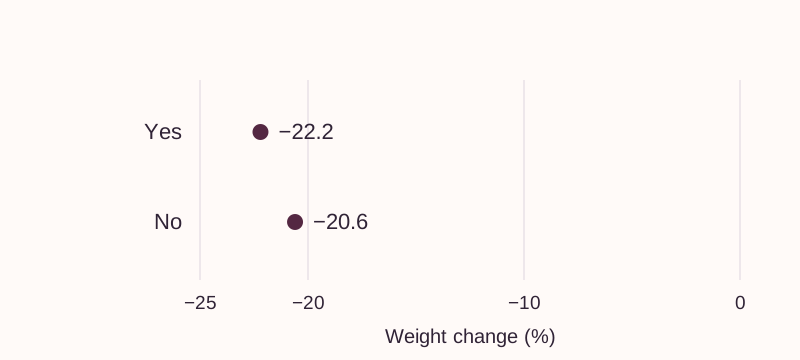
| NVD | Change (%) |
|---|---|
| Yes | −22.2 |
| No | −20.6 |
Treat outcome availability as part of the question
Outcome availability changes what must be learned before an estimate can be extended. Consider two hypothetical analysts given the same retained records. One also learns that absent measurements resulted from a recording interruption unrelated to the outcome. The other learns only that the reason for absence is unknown. They can calculate the same observed summary while having different grounds for applying it beyond those records.
The distinction concerns identification, not arithmetic. More precise calculation of the retained values cannot reveal the values that were never observed. To reach a broader target, an analyst needs an assumption connecting missing outcomes with information that is available. A plausible assumption should be stated in terms that could be challenged, rather than hidden behind the choice of a calculation.
A proposed sensitivity analysis could ask how the conclusion would change if unavailable outcomes systematically differed from otherwise comparable available outcomes. Its purpose would be to locate the point at which the interpretation becomes fragile. This is a suggested test of an assumption, not a description of methods reported by the source or a claim about actual missing outcomes.
Exposure and observation should also be separated in that hypothetical protocol. Ending an intervention does not logically require ending measurement, and an unavailable measurement does not establish that an intervention ended. Recording both processes would make it possible to distinguish questions about continued exposure from questions about everyone initially assigned.
The strongest extension would explain why the missing records would or would not change the intended conclusion, using relevant information about their absence. Merely describing the retained records in greater detail cannot establish that bridge. The reader should ask what evidence bears on the unobserved part, not treat its invisibility as evidence of similarity.
Ask what a binary classification leaves unresolved
A binary classification can answer whether a defining condition was met. It cannot, by itself, reconstruct the history that produced the code. The question is therefore not whether a binary variable is inherently poor, but whether the intended inference demands information that the coding discards.
Imagine two explicitly hypothetical histories. In one, a recorded condition appears early and resolves before a later outcome is measured. In the other, it appears only shortly before that outcome. Both could receive the same membership code under a rule that asks whether the condition occurred at any time. Yet a causal explanation invoking an earlier influence would need to distinguish those sequences.
Recurrence introduces a different ambiguity. A single occurrence and repeated occurrences could share a code without representing the same accumulated experience. Intensity and duration are separate dimensions again: neither can be deduced from the fact of membership. An analysis should choose the dimensions required by its question before treating a convenient category as a complete exposure history.
Timing also affects opportunity to be classified. In a hypothetical comparison with unequal observation periods, a person followed longer has more opportunities to meet an event-based rule. A proposed analysis would need to define a common window or explain how differing opportunities enter the interpretation.
These examples do not establish any such pattern in the study. They specify the information a stronger temporal explanation would need: the order of relevant changes, the window of observation and a classification rule aligned with the proposed cause. More elaborate labels would not solve the problem unless the underlying measurements supported them.
Design a more complete outcome report
A more complete outcome report could begin with separate statements of assignment, exposure, observation and outcome. For each proposed scientific question, the reader should be able to trace how those elements determine inclusion. The report would show whether a changed question requires different records, rather than allowing a single sample description to stand for every analysis.
An observation diagram could record when measurements were expected and what became unavailable. An outcome table could then state the target quantity for each comparison. These proposed displays would connect the population description to the estimate, making it harder to interpret a conditional result as an answer about a broader population without explanation.
Precision and sensitivity deserve separate treatment. A narrow uncertainty interval under one model addresses variation within that model's assumptions. It does not test whether an assumption about unavailable observations is correct. Conversely, a sensitivity exercise that changes the assumptions is not simply a wider version of the original interval. It asks how much the answer depends on choices that the observed data cannot fully settle.
The Analysis of treatment discontinuation offers a separate endpoint-reading exercise. The transferable habit is to define the outcome before evaluating the statistic.
A useful final display would distinguish conclusions that remain stable across credible assumptions from conclusions that change materially. It would also say which new information could resolve the remaining ambiguity. This turns a limitations paragraph into an actionable research question, while leaving the original target and any broader proposed target visibly separate.
Check product and population before transporting a result
Transporting a result requires a sequence of defensible connections. One concerns the intervention's identity; another concerns the population and setting. Success at one connection does not establish the other. A well-defined estimate inside a study can still require additional evidence before it supports a different application.
Consider a hypothetical transfer argument: if the intervention relevant to the new setting matches the intervention defined by the research question, and if the outcome relationships needed for that question carry across populations, then an extension may be justified. Each condition must be examined independently. A familiar name cannot establish the first condition, and a shared broad diagnosis cannot establish the second.
The distinction also matters when reading comparisons. A difference between results drawn from separate settings can reflect differences in the questions, populations or observation rules. To make a comparative claim, the reader would need a common target and a defensible way to separate those differences from the contrast of interest.
The Semaglutide and tirzepatide comparison guide is additional reading, not a substitute for that argument. A practical transfer note would state the proposed application, list the necessary matching conditions and identify which are supported. Where a condition remains unresolved, the uncertainty should remain attached to that step. It should not be concealed by presenting the final estimate with the same confidence as the original calculation.
Make analytic choices accountable
Lilly funded this analysis; six authors disclosed employment and shareholding.[1]
Accountability requires a record of choices that another reader can reconstruct. For an outcome analysis, that record should connect the grouping rule, outcome time, eligible observations and uncertainty calculation. It should also distinguish decisions fixed before examining results from decisions made afterward. Openness makes these choices inspectable; it does not establish that each choice was correct.
A useful review would ask what alternative decisions were scientifically plausible and whether they would answer the same question. Changing a target population is not merely another way to estimate an unchanged target. Keeping a decision history would expose that distinction and allow criticism to focus on the actual inferential step.
The CoreAge Rx review is a separate exercise in checking dated provider documentation, not support for a clinical inference.
For research interpretation, the relevant standard remains traceability: a reader should be able to connect each conclusion to its specified population, outcome and assumptions, and identify what evidence could overturn it.
Keep clinical decisions outside the chart
Zepbound delays gastric emptying and is not recommended with severe gastroparesis. Contraindications include personal or family medullary thyroid carcinoma history, multiple endocrine neoplasia type 2, and serious tirzepatide or ingredient hypersensitivity. Persistent or severe abdominal pain needs prompt assessment; gastrointestinal dehydration can damage kidneys.[3]
Compounded products lack FDA approval.[4]
A clinical decision asks what to do for a particular person under current circumstances. An aggregate outcome summary addresses a different question. Even a convincing population estimate leaves individual priorities and relevant personal information outside the average. Reading a result carefully therefore includes recognizing the decision it cannot make.
Symptoms should not become a target merely because a reader hopes to reproduce a favorable outcome. A scientific explanation must distinguish describing an association from recommending a course of action. The chart is a tool for examining a research claim; it cannot perform an individualized clinical assessment.
Reader questions
Does a randomized trial make every later subgroup comparison randomized?
Randomization supports comparisons defined by the allocation process. A later rule can select people according to additional characteristics or events. To evaluate that comparison, ask what determines membership and whether those determinants also matter for the outcome. The original allocation rule does not answer those additional questions.
What would be needed to extend an estimate beyond the observed records?
First define whose outcomes the extension would cover. Then state the assumption connecting unavailable outcomes to available information and explain why it is credible. A proposed sensitivity analysis should show when the conclusion changes under alternative assumptions. Collecting relevant missing-outcome information would address a different problem from merely calculating an observed mean more precisely.
Can an average alone establish that two people will respond alike?
No. An average does not describe the full spread of individual responses or establish that a prediction applies to either person. A claim of similar responses requires a defined meaning of similarity, information about variability and uncertainty, and evidence relevant to the individuals. Matching averages alone cannot provide that information.
Editorial assessment
The soundest interpretation begins with a match between the claim and the records capable of answering it. A population description establishes an entry point; it does not complete the argument from observed outcomes to a wider target. A stronger claim would need explicit links between eligibility, membership, observation and the intended outcome, with uncertainty attached to each extension. The useful next evidence would be information that distinguishes competing explanations, especially information about outcome availability and the temporal structure of classification. Additional decimal places would not perform that work. An analysis earns a broader interpretation by making those connections defensible, not by making its summary more emphatic. Readers can use this standard to recognize both a well-defined descriptive contribution and the further evidence required for causal explanation or individual prediction.
Limits of this analysis
This article examines how to interpret research estimates. It does not reanalyze participant records, supply missing outcomes or resolve the assumptions needed for a broader causal claim. Hypothetical examples illustrate logical distinctions and are not reported trial observations. The discussion does not provide an individualized clinical assessment.
References
- Rubino (2025) · Diabetes Obes MetabSource checked 2026-10-28
- le Roux (2023) · ObesitySource checked 2026-10-28
- ZEPBOUND · NLMSource checked 2026-10-27
- FDA GLP-1 · FDASource checked 2026-10-27
Our methodology · Advertising disclosure · Request a correction