A treatment decision is an outcome of its own
What exactly changes when a treatment is discontinued? A record can establish that a decision occurred without establishing every experience that preceded it or every outcome that followed. The scientific task is to specify which of those quantities the analysis seeks to describe. Otherwise, a percentage about an action may be read as though it measured symptoms, overall health or the likelihood of completing a study. Those substitutions require information that the action alone cannot supply.
Consider an explicitly hypothetical record: a participant reports a symptom, stops the assigned treatment and later attends an assessment. Those statements describe different events. The symptom has an occurrence and perhaps a duration; the stop has a date and an attributed reason; the assessment supplies an observation. A different hypothetical participant could report the same symptom, continue treatment and attend the same assessment. Knowing which person stopped would not tell us whose symptom lasted longer.
An endpoint therefore needs a precise question before it needs a comparison. Was the intended quantity the occurrence of a symptom, a decision attributed to it, or a subsequent change in health? Keeping these questions separate makes the result more useful, because each supports a different inference. It also prevents an apparently reassuring or concerning label from replacing an examination of what was actually counted.
Identify the intervention and the eligible population
STEP-1 and STEP-3 enrolled adults without diabetes: BMI ≥30, or ≥27 with a weight-related condition. STEP-2 required type 2 diabetes and BMI ≥27. All tested weekly subcutaneous semaglutide 2.4 mg versus placebo over 68 weeks; STEP-3 added intensive behavioral therapy.[2]
Eligibility and intervention identity define the first boundary of interpretation. A population statement concerns people represented under specified conditions; it is not automatically a statement about anyone who recognizes the ingredient name. Before asking whether a result applies elsewhere, identify the original question and the new target. The necessary comparison is between those descriptions, rather than between the familiarity of the product names.
Imagine a person who meets every stated eligibility requirement and another who falls outside one of them. This hypothetical contrast does not justify assigning the second person an invented increase or decrease in risk. It identifies an unanswered transport question. We would need evidence about whether the excluded characteristic changes the outcome or the circumstances producing it. Conversely, meeting an eligibility checklist would establish membership in a defined group, not a personalized forecast within that group.
The intervention also needs its own description, separate from the population. A transferable inference would require an explanation of which treatment features must remain comparable and why differences would not alter the question. The Semaglutide profile provides a separate identity reference. Reading it alongside a study description can help organize that comparison, but neither an ingredient match nor an eligibility match completes the argument by itself. Both premises need to be established before a broader conclusion follows.
Read the chart as a specific reason for stopping
Post hoc percentages were trial-adjusted; on-treatment events required a dose within the previous 49 days.[1]
Before comparing the bars, translate the endpoint into a question that a participant record could answer. For a reason-specific stopping measure, the relevant indicator would identify whether a person met the stated stopping definition. A list of symptom episodes answers another question. If a hypothetical participant had several episodes before a single stopping decision, treating every episode as another person would change both the unit and the meaning of the analysis.
An attributed reason also differs logically from an intensity rating. A record saying why treatment ended would not, without additional information, rank the experience on a severity scale. Nor would it identify every possible reason for ending treatment or establish that observation ended. The useful reading discipline is to preserve the noun and qualifier together: which action, attributed to which category, among which participants? Removing a qualifier broadens the claim without broadening the underlying information.
To reproduce an adjusted percentage, an analyst would need the calculation's ingredients: the eligible participants and qualifying outcomes within each contributing trial, the specified weighting rule, and the treatment of records that do not contribute to a particular calculation. Event totals alone cannot supply that structure. A reproducibility check should therefore attempt to recover the reported quantity from the defined inputs, rather than substitute a convenient unweighted ratio. If the calculations differ, the next question is which definition or weighting choice differs, not which answer looks more plausible.
Reading the stopping measure
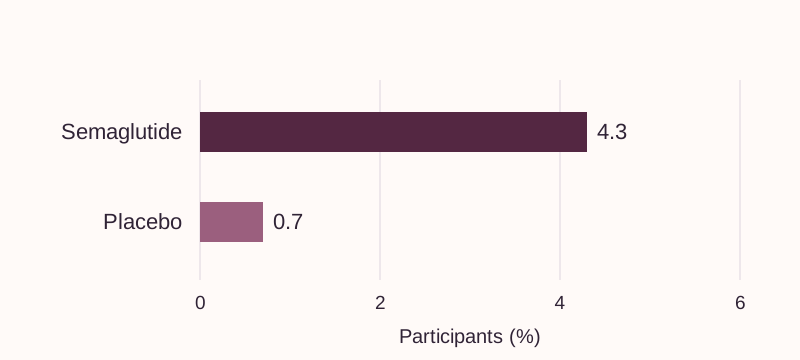
| Arm | Participants (%) |
|---|---|
| Semaglutide | 4.3 |
| Placebo | 0.7 |
Keep treatment status separate from observation
A useful hypothetical follow-up sheet would keep separate columns for treatment status, contact with the participant and availability of the particular outcome. Suppose treatment is marked stopped, a later assessment is attended and the outcome is recorded. No contradiction exists. Now suppose treatment remains marked ongoing, but the outcome field is blank. The treatment column cannot fill that blank. These examples establish a logical distinction without claiming any frequency of either pattern.
The distinction matters when specifying the question an analysis should answer. A question about the consequences of assignment can seek outcomes after subsequent treatment decisions. A question restricted to periods of continuing exposure instead conditions attention on that treatment state. Both can be formulated coherently, but they describe different targets. One cannot silently replace the other merely because the same participants initially appear in both datasets.
In the hypothetical sheet, filtering out everyone after a stop would discard recorded outcomes as well as potentially unrecorded ones. Calling every discarded row missing would then confuse an analytical exclusion with a failure to observe. The appropriate explanation would distinguish why a value is absent from the analysis: it was never measured, it was measured but excluded by the question, or it exists but cannot be used under a specified rule.
This distinction also changes what additional evidence would help. To investigate incomplete observation, ask about the availability of the relevant measurements. To investigate an exposure restriction, ask how and when that restriction was applied. A general completion label would answer neither question adequately. A transparent report would connect each inclusion decision to the outcome being estimated, so that a reader could tell whether a changed result reflects changed experiences or changed selection.
Specify the population behind a pooled percentage
Consider a purely hypothetical population divided into two strata, each with a fixed rate of a defined stopping outcome. Suppose the rates differ. If the combined population gives more weight to the stratum with the higher rate, its overall rate rises even though neither stratum's rate changes. This is a property of a weighted average, not evidence that an intervention changed anyone's outcome or that a particular trial had the higher rate.
A standardized summary makes that mixture part of the question. It asks what summary would result under the chosen representation of the component groups. To interpret it, the reader needs to know what the weights represent and why that reference mixture is relevant. A different reference can produce a different summary while leaving the underlying group-specific information intact. Choosing a reference is therefore a substantive decision about the population being described.
The same logic limits individual prediction. Even a perfectly reconstructed group summary would not identify an individual's position within that group. Additional information would be needed about characteristics relevant to the outcome, how those characteristics combine, and the uncertainty of predictions for people with that combination. A population percentage cannot provide those conditional relationships simply by being adjusted.
For a comparison intended to distinguish treatment groups, a useful diagnostic question is whether the summaries describe comparable population mixtures. If the mixtures differ, a difference between summaries could reflect composition as well as the outcomes being compared. Holding the reference population explicit makes that possibility inspectable; it does not, on its own, prove that every remaining difference has a causal explanation.
Make assumptions about missing outcomes visible
Imagine a proposed follow-up study in which some final outcomes are not obtained. One hypothetical explanation is that the missingness is unrelated to those outcomes. Another is that people with a particular unobserved outcome are especially likely to be missing. Equal numbers of blank records would not make these explanations equivalent. The blanks disclose how many observations are unavailable, but they do not reveal what values would occupy them.
The inferential consequence depends on the relationship between missingness and the outcome. Under the first explanation, the observed records might remain informative about the unobserved ones. Under the second, relying on that resemblance could systematically misrepresent the missing group. Neither explanation should be accepted merely because it produces an attractive answer. The question is what observed information or study procedures could support the assumed relationship, and what important uncertainty would remain.
A proposed sensitivity analysis could make the dependence visible by assigning different outcome patterns to the unavailable records and examining how the conclusion changes. The scenarios should have stated rationales; they are not recovered observations. This exercise could identify whether a conclusion survives materially different assumptions or depends on a narrow choice. It should also distinguish a change in the estimated result from a change in how confident the analyst is about that result.
The Analysis of outcome availability offers a separate reading exercise about analytical selection. For the hypothetical study here, a useful report would specify which outcomes are missing, which participants they concern and which assumptions connect them to observed records. It would not treat an overall retention figure as a substitute for outcome-specific completeness. Different measurements for the same participant could require different assumptions.
Report benefit and harm without collapsing their meaning
A more complete benefit-and-harm report could retain several defined outcomes for each participant: the intended benefit, the burden of an unwanted experience and treatment status at a specified assessment. Recording them together would permit questions about their overlap while preserving their distinct meanings. This is a proposed structure for analysis, not a statement that any particular dataset contains those measurements.
Separate group summaries cannot determine that overlap. In a hypothetical dataset, the participants with the greatest benefit might also have the greatest unwanted burden; in another, those experiences might occur in different participants. Group averages could be compatible with either arrangement. To distinguish them, the analysis would need linked participant-level outcomes and an explanation of which records are jointly available. Matching group denominators would not by itself supply the missing pairing.
Timing adds another dimension. If benefit is assessed at one occasion and burden across a different interval, their association has to be interpreted with that mismatch in view. A proposed joint report should say whether it compares experiences at the same time, accumulates them over time, or relates an earlier experience to a later outcome. These alternatives are scientifically different even when the same outcome names appear.
A composite measure could answer a further question by assigning explicit priorities or weights to its components. However, a common total could arise from very different component patterns. Readers would need both the composite and its components to understand the tradeoff being represented. The weights should be justified as choices about the question or preferences, not presented as a discovery that makes the separate outcomes interchangeable. A treatment decision alone cannot perform that balancing work.
Require an explicit bridge to a different product
Transferring an inference to a different product requires more than recognizing a shared word. Write the proposed argument as a sequence of premises: the intervention is sufficiently comparable, the target population is relevant, the outcome has the same definition, and the surrounding care conditions do not defeat the intended comparison. Each premise addresses a different route by which the original question could change.
For example, imagine a hypothetical offer identified only by an ingredient string. That information does not establish the other premises. It leaves unspecified the treatment description needed for comparison, the people to whom the inference is being applied, and how outcomes would be measured. The appropriate conclusion is that the argument is incomplete. It is not a numerical adjustment to the study result, nor a declaration that the hypothetical offer necessarily produces better or worse outcomes.
The Compounded medication approval guide is a separate destination for reading about regulatory status. A regulatory question and a transport question should each retain their evidentiary requirements. Even if one were resolved, it would not automatically answer the other. For scientific interpretation, the decisive step is to identify the missing premise and the type of evidence that could establish it. This keeps a reference to a study from becoming an unsupported conclusion about a named offer.
Make the inference auditable
Novo Nordisk funded trials and writing; three authors disclosed employment and shareholding.[1]
An auditable inference should leave a path from the question to the displayed result. A reviewer could begin with the endpoint definition, identify which participants qualify for its denominator, trace which records enter the numerator, and reproduce the calculation. A protocol and statistical plan would help establish which choices were specified before results were examined and which choices require a later explanation. This is a proposed audit sequence, not a claim that every needed record has been obtained.
Disclosure provides context for scrutiny without deciding the result. A method can be evaluated by asking whether another analyst could reproduce it, whether alternatives would answer a materially different question, and whether the report distinguishes planned analyses from subsequent exploration. Agreement with an expected conclusion is not a substitute for those checks. Equally, disagreement with a sponsor's interests would not establish that the method is sound.
The CoreAge Rx review invites a separate examination of dated provider documents. It supplies no premise about clinical equivalence or outcomes for the statistical argument developed here.
Separate interpretation from clinical action
Wegovy delays gastric emptying and is not recommended with severe gastroparesis. Contraindications include personal or family medullary thyroid carcinoma history, multiple endocrine neoplasia type 2, and prior serious semaglutide or ingredient hypersensitivity. Persistent or severe abdominal pain needs prompt assessment; gastrointestinal dehydration can damage kidneys.[3]
Compounded products lack FDA approval.[4]
The interpretation of a population measure and a decision about a particular person require different information. A chart's relative bar sizes cannot establish whether an individual's situation meets a clinical condition for action. Nor can a general methodological argument resolve an uncertainty about that person's current presentation.
The useful boundary is to keep the questions explicit. Scientific interpretation examines how a defined result was produced and which broader claims would follow from it. Individual assessment must address the person's actual circumstances. Treating either exercise as a substitute for the other would leave essential premises unexamined.
Reader questions
Does stopping treatment mean that all later outcomes are unknown?
No logical implication connects those statements. In a hypothetical record, treatment could stop while later measurements remain available. To determine what is known, inspect each outcome's observation status separately from exposure status. Also distinguish a measurement that was never obtained from one deliberately excluded by the analysis being considered.
Can an adjusted pooled percentage describe every eligible person?
It describes a population under a specified averaging rule. An individual prediction would additionally require relevant conditional relationships and evidence about their predictive uncertainty. Eligibility alone does not supply that information. Before applying a summary to a person, identify which features of the population-level question would need to become person-specific.
What would make benefit and harm reporting more complete?
Link clearly defined outcomes within participants, specify their assessment periods, and account for whether they are jointly observed. Report the separate components alongside any proposed combined measure. That structure would let readers distinguish an actual overlap of benefit and burden from a tradeoff imagined by comparing unrelated group summaries.
Editorial assessment
A defensible interpretation begins by preserving the treatment decision as its own outcome. Broader claims require additional relationships to be established: between symptoms and decisions, between treatment status and observation, and between population summaries and the people or products to which they might be applied. None of those relationships is supplied merely by placing percentages next to each other. The strongest next step would be an explicit account of the target population, inclusion rules, observation availability and joint outcomes, accompanied by sensitivity checks for assumptions that cannot be established from observed records. Such an account would make disagreement productive: readers could locate it in a definition, a missing measurement, a weighting choice or a transport premise. That is a more precise scientific judgment than treating a stopping measure as a verdict on every dimension of treatment.
Limits of this analysis
This is an educational analysis of how a defined outcome can be interpreted. The hypothetical records and proposed analytical checks are reasoning tools, not observed participant histories or additional study findings. The article does not establish an individual's prognosis, evaluate a provider's clinical performance or claim independent medical review.
References
- Wharton (2022) · Diabetes Obes MetabSource checked 2026-10-28
- Kushner (2020) · ObesitySource checked 2026-10-28
- WEGOVY · NLMSource checked 2026-10-27
- FDA GLP-1 · FDASource checked 2026-10-27
Our methodology · Advertising disclosure · Request a correction